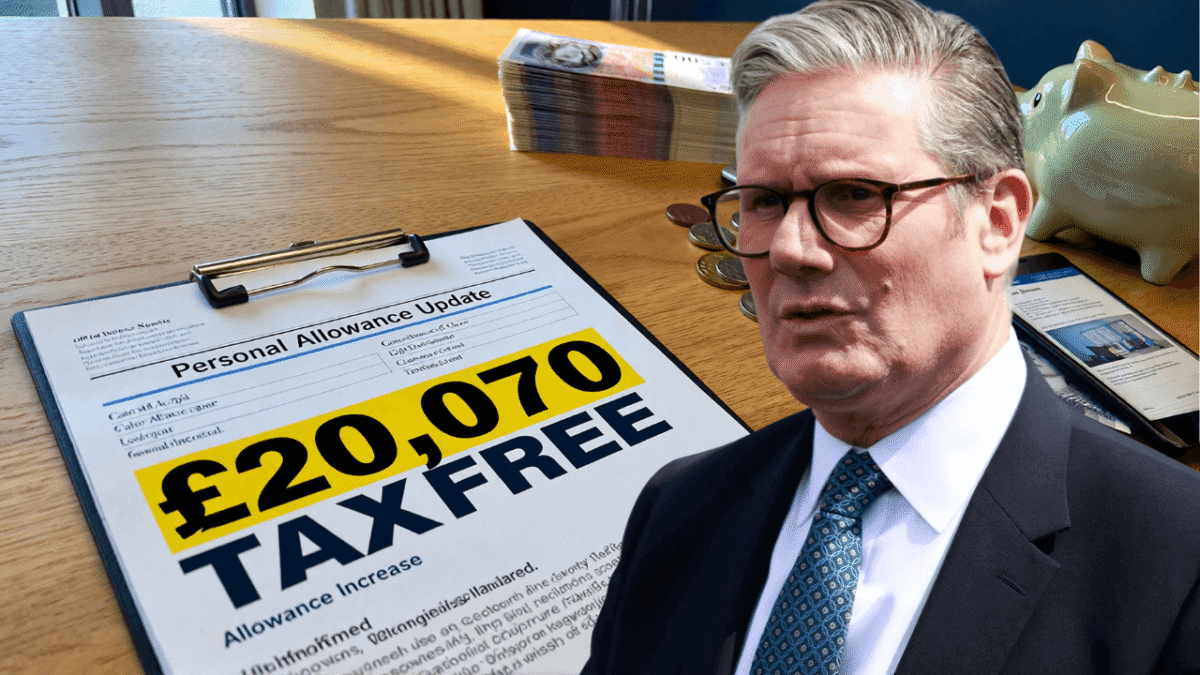
Over the past few days, a headline has been circulating online claiming that HMRC has confirmed a rise in the UK tax-free Personal Allowance to £20,070. For many workers and pensioners, this sounds like excellent news. After all, a higher tax-free allowance would mean more money kept in your pocket each month.
However, as with many financial headlines, the real situation is a little more detailed than it first appears. Before expecting a large tax cut, it’s worth understanding what has actually changed — and what hasn’t.
This article explains the full picture in plain, straightforward language so that anyone can understand what the £20,070 figure really means.
What the Personal Allowance Actually Is
The Personal Allowance is simply the amount of money you can earn each year before you start paying Income Tax.
For most people in the UK, this applies to income such as:
- Wages or salary
- Pension income
- Self-employment earnings
- Certain taxable benefits
Once your income goes above this limit, tax is charged according to the normal income tax bands.
Because of this, any change to the Personal Allowance affects millions of people — which is why headlines about it attract so much attention.
Has the Personal Allowance Really Increased to £20,070?
The short answer is no.
The standard Personal Allowance has not officially risen to £20,070. The current allowance remains at £12,570 per year for most taxpayers, and this figure has stayed the same for several years.
So why are people seeing the larger number online?
The £20,070 figure comes from a misunderstanding involving multiple tax-free allowances being combined together, rather than one single increase announced by HMRC.
Where the £20,070 Figure Comes From
Some financial discussions explain that certain individuals can legally earn more income without paying tax by using several allowances at the same time.
For example, someone might combine:
- The standard Personal Allowance
- Savings allowances
- Rental income relief schemes
- Other tax-free thresholds depending on circumstances
When these are added together in specific situations, total tax-free income could reach or approach around £20,000.
But this does not mean the Personal Allowance itself has changed. It simply means different tax rules can work together depending on a person’s financial situation.
Why the Allowance Has Stayed Frozen
In fact, government policy in recent years has been to keep the Personal Allowance frozen rather than increasing it annually.
This means that even though wages and pensions may rise, the tax-free threshold stays the same. Over time, more people begin paying tax or move into higher tax bands — something economists often describe as “fiscal drag.”
The freeze was introduced to help stabilise public finances without officially raising income tax rates.
What This Means for Workers and Pensioners
Because the allowance has not increased, many people may notice that small pay rises do not translate into as much extra take-home pay as expected.
For pensioners, this is particularly noticeable because State Pension payments increase each year, gradually pushing more retirees into taxable income territory.
So while headlines suggest a tax break, the practical reality for most households remains unchanged.
Are There Still Ways to Earn More Tax-Free?
Yes — even though the main allowance hasn’t increased, there are still legal ways to reduce your tax bill.
Some commonly used options include:
- Transferring part of an allowance between married couples if one partner earns less
- Using tax-free savings accounts
- Claiming eligible reliefs or deductions
- Making pension contributions that reduce taxable income
These options don’t change the official allowance, but they can reduce how much tax you pay overall.
Why Headlines About Tax Changes Can Be Misleading
Tax rules are complex, and when simplified into short headlines, important details are often lost.
A statement like “£20,070 tax-free income” sounds straightforward, but it usually refers to a specific scenario rather than a universal rule.
Because tax news affects nearly everyone, even small misunderstandings can spread quickly across social media and news websites.
Reading beyond the headline helps avoid unrealistic expectations.
Will the Personal Allowance Increase in the Future?
Tax thresholds are usually reviewed during government budget announcements. While increases are possible in the future, no confirmed policy currently raises the Personal Allowance anywhere near £20,070.
Any official change would normally be announced well in advance and applied nationwide automatically.
Until then, taxpayers should assume the existing allowance remains in place.
What You Should Do Now
Rather than waiting for a large allowance increase, it may be more useful to review your current tax situation.
Simple steps can include:
- Checking your tax code
- Reviewing pension contributions
- Making use of tax-efficient savings
- Ensuring you claim any reliefs you qualify for
Small adjustments can sometimes make a noticeable difference to take-home income.
Final Thoughts
The headline claiming HMRC has confirmed a £20,070 tax-free Personal Allowance has caused understandable excitement, but it does not reflect an official nationwide change.
The Personal Allowance itself remains unchanged, and the larger figure comes from combining different tax rules rather than a single increase.
While that may feel disappointing at first, understanding how allowances actually work can help people make better financial decisions and avoid confusion created by oversimplified headlines.
In short, there is no sudden tax-free windfall — but there are still practical ways to manage your taxes wisely under the current system.